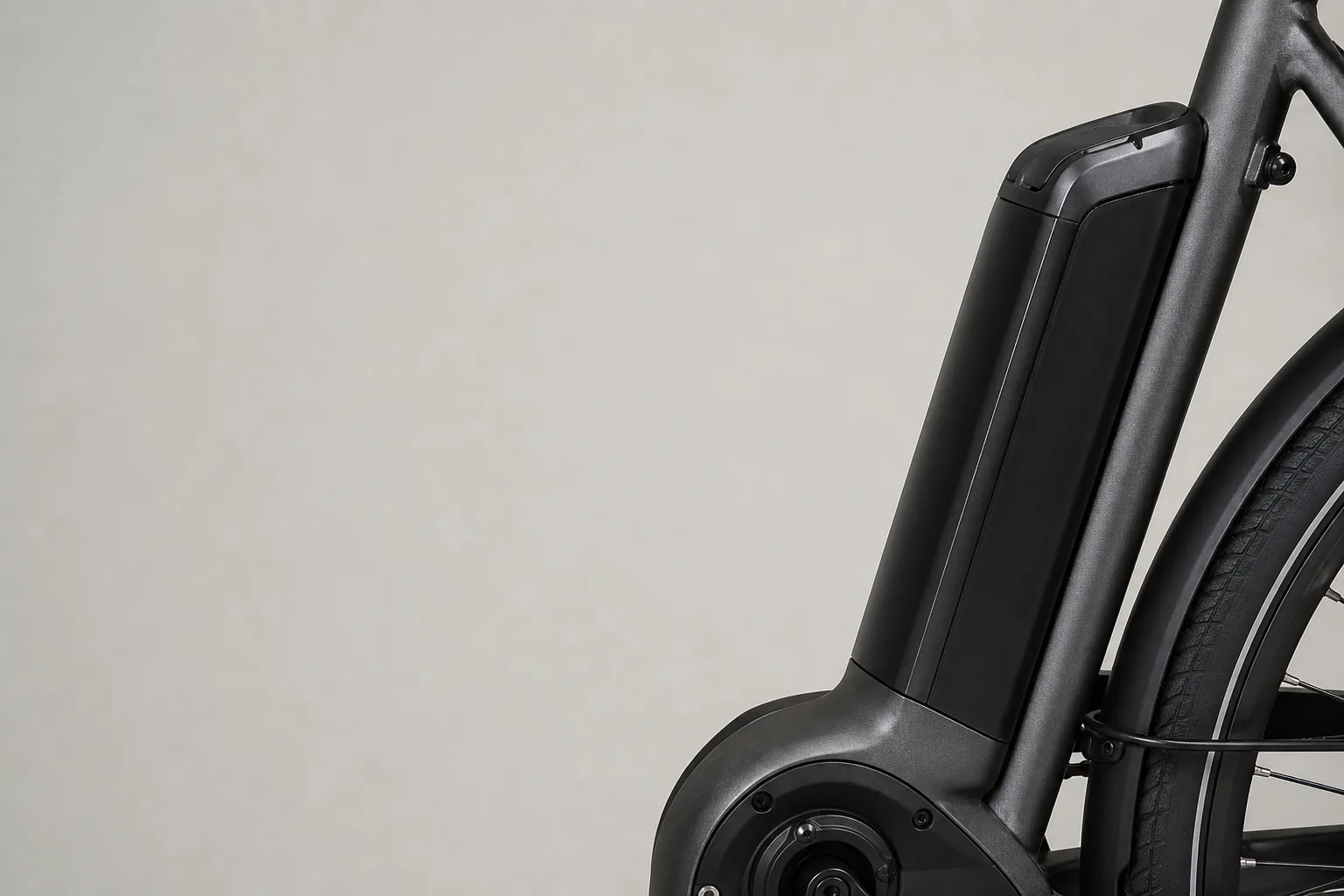
The battery is the part of an electric bicycle most likely to end its useful life while the rest of the bike is still perfectly good. Frames outlast their riders, motors are simple, and controllers fail rarely. A pack, by contrast, loses capacity every year whether you ride or not, and at some point the range you get on a full charge no longer covers the errand you bought the bike to do. That is a maintenance event, not a disaster, provided somebody still sells the pack. The question is how to tell in advance.
Generic case formats against integrated packs
Two families of battery exist on the market, and they age very differently in terms of availability. The first is the standard case format: rectangular downtube packs and rear-rack packs built around a small number of widely licensed shells, sold under names like Hailong, Shark, Jumbo Shark and Dorado. Dozens of brands use them, several factories build them, and a pack can be sourced years later from a supplier who has never heard of your bicycle. The second family is the integrated pack, shaped to one manufacturer's downtube, often semi-hidden, usually beautiful, and available from exactly one source.
Low step-over frames complicate this in a way worth understanding before you shop. A step-through downtube is shorter and often curved, so it cannot always carry a long rectangular pack, and designers respond either by mounting the battery on a rear rack, which is generic and easy to replace, or by molding a custom pack into the frame, which is neither. Neither choice is wrong. But a rack pack on a low frame is a bet you can win five years out with no help from the original brand, and that has real value.
Reading cell branding and capacity claims
Inside the case, capacity comes from cylindrical cells, usually the 18650 or the larger 21700 format, wired in a grid. Listings that name the cell maker, typically Samsung, LG, Panasonic or Sony, are telling you something checkable. Listings that say only "A-grade cells" or "branded cells" are telling you nothing. Capacity itself is arithmetic: watt-hours equal volts multiplied by amp-hours, so a 48-volt pack rated at 14 amp-hours holds roughly 672 watt-hours, and any brand quoting only amp-hours is making comparison harder than it needs to be. Convert everything to watt-hours before you compare two bikes.
Certification marks belong in the same reading. UL 2849 covers the whole electrical system of an e-bike and UL 2271 covers the battery pack, and the Consumer Product Safety Commission is the federal body responsible for e-bike battery safety in the United States. A brand that has paid for third-party certification has also, incidentally, committed to a fixed pack design and a documented supply chain, which is a mild but genuine signal that the same pack will be buildable later.
What the warranty language actually promises
Battery warranties are short, commonly one or two years, and they are almost never a promise about range. Read for three things. First, whether coverage is prorated, meaning the payout shrinks month by month rather than replacing the pack outright. Second, whether there is a capacity threshold, phrased as a percentage of original capacity retained after a stated number of charge cycles, because without one there is no test a failing pack can fail. Third, whether the remedy is a replacement pack or a store credit. A credit tells you the company expects the pack to change.
Judging whether the seller answers the phone later
Ask the shop, in person, what a replacement pack for that exact model costs today, and see whether they can quote it without a phone call. A dealer who stocks packs for the bikes on the floor has already solved the problem for you. Look for a public parts page with part numbers, a published exploded diagram, and a phone number staffed by people rather than a form. Ask how long the brand has been importing under this name. Ask whether the pack shares a case with anything else. Prices for a replacement typically run to a substantial share of the bike's original cost, which is precisely why the answer matters before you buy rather than after.
A pack that uses a common case, names its cells, states watt-hours plainly, carries a UL listing and is stocked by a shop twenty minutes away is a serviceable component with a known replacement path. That combination is available at most price points, on step-through frames as readily as on any other, and finding it takes about ten minutes of reading.